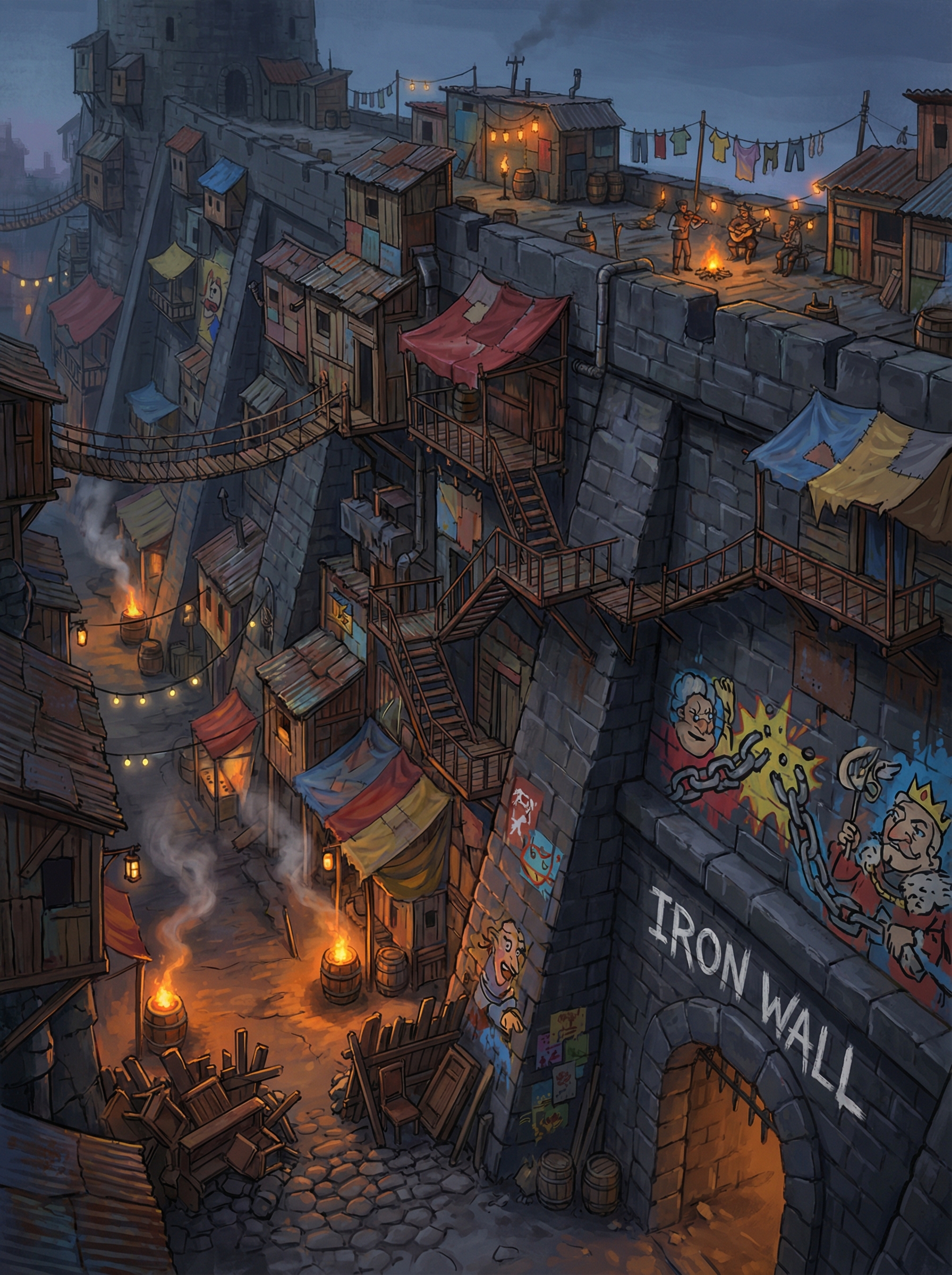
The District, known as the Iron Wall, has a history steeped in necessity and defiance, though its exact founding and abandonment dates remain unknown. Centuries ago, during the height of a devastating Civil War, the aristocracy of Ironhold initiated its construction. This massive inner curtain wall was intended to separate the noble districts from the perceived threat of refugees streaming from the corrupted Bukhara Spire Gateways. It was designed as a sterile defensive barrier against the incoming populace.
As the war intensified and Ironhold's population dramatically swelled, habitable space became an urgent premium. The very workers essential to the noble lifestyle – servants, cooks, masons, and laborers – found themselves with nowhere to live. Necessity became the mother of invention as refugees and workers began ingeniously building into and onto the existing wall structure.
Wooden shanties were bolted directly into the stone, storage alcoves were transformed into family homes, and the patrol walkways became the district's bustling main thoroughfares. It was during this period that bored construction workers, while building, scrawled what appeared to be ancient protective runes near the market; in reality, these were merely laundry lists and crude jokes written in a now-dead dialect. Over time, the Iron Wall evolved into the vibrant "Melting Pot of Ironhold."
This new vertical city was born from a shared struggle against poverty and the profound indifference of the ruling class, blurring cultural lines among its residents. While noble factions like the House of Silk viewed the district as little more than a "kennel" for their workforce, the inhabitants forged a deeper, inspiring history. During the darkest days of the slave trade, the Iron Wall transcended its role as a mere residence, becoming a crucial sanctuary.
A secret society, the Iron Collective, formed among maids, butlers, and laborers. By night, while publicly serving slavers and merchants, they hollowed out sections of the wall to create a hidden "Under Wall." They smuggled escaped slaves through the district's labyrinthine ventilation shafts, falsifying servitude papers to grant them freedom, a secret known only to the oldest families.
Today, the Iron Wall district retains its bohemian and egalitarian spirit, standing as the beating heart of Ironhold's culture, alive with music, food, and debate. However, the physical structure itself is in a state of advanced decay, with several precarious hidden secrets. For instance, the structural integrity of the entire northern section is entirely dependent on a single calcified root system from a dead tree, treated as a shrine by locals who are unaware of its critical architectural role.
Furthermore, the district's most famous "eternal flame," a fire pit celebrated as a symbol of undying rebellion, is actually fed by a slow natural gas leak. No one knows how to properly fix the leak, so the fire is deliberately kept lit to prevent a catastrophic explosion. This particular fire, along with other unchecked blazes, is a symbol of the residents' refusal to pay the city's exorbitant fire protection tax, choosing instead to manage their own hazards.
The district currently simmers with unrest, a veritable powder keg. Barricades are frequently erected to prevent the City Watch from conducting raids, effectively turning the Iron Wall into a semi-autonomous zone. Here, the law of the nobles holds little sway, replaced by the collective will and resilience forged over centuries within its stone and shanty walls.